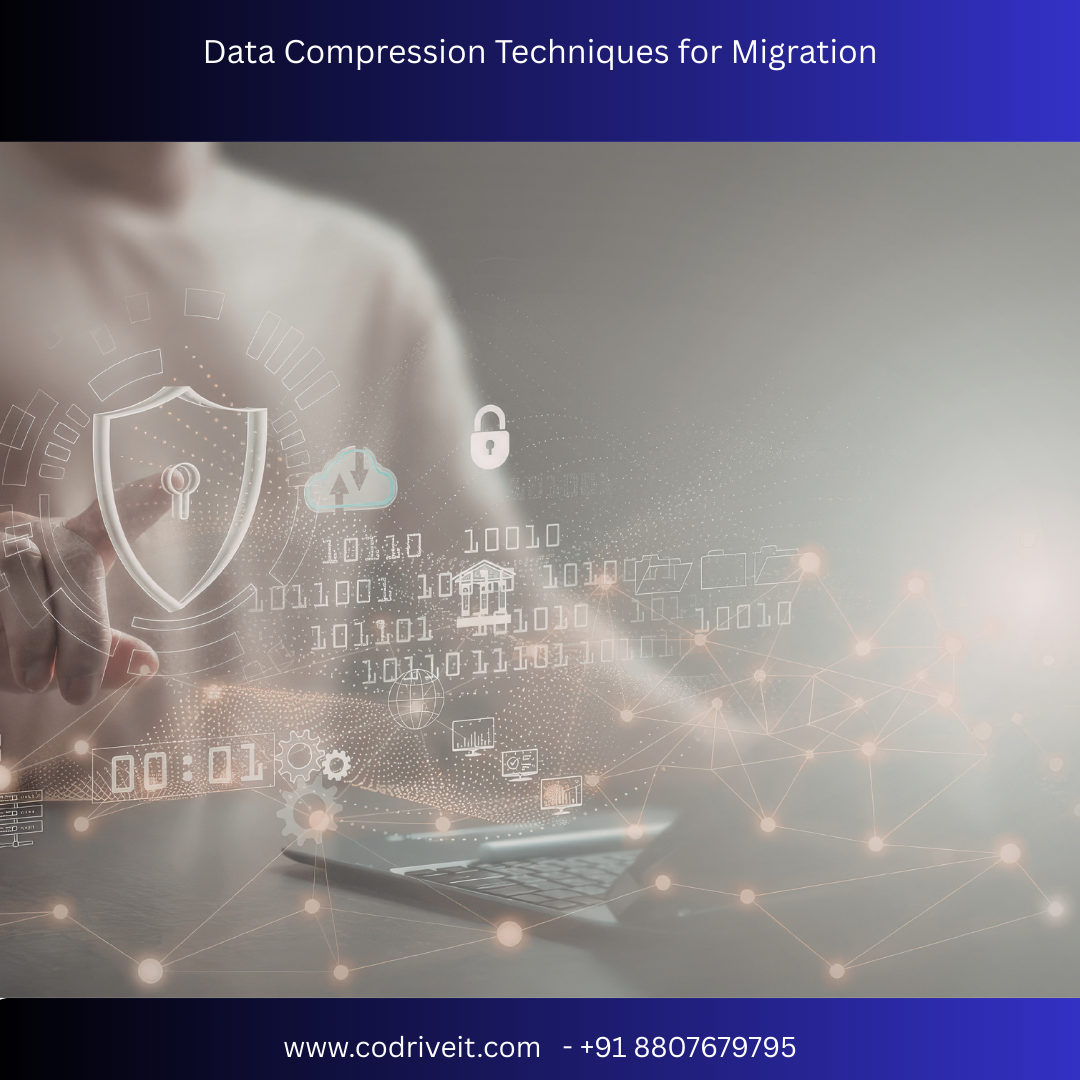

Data migration projects often involve transferring massive volumes of data between systems, databases, or cloud platforms. Moving large datasets without optimization can lead to slow transfer speeds, high network usage, and increased operational costs. Data compression techniques for migration help organizations reduce data size, accelerate transfers, and optimize storage utilization.
By applying effective compression methods, businesses can ensure faster and more efficient migration while maintaining data integrity and security.
Data compression in data migration refers to reducing the size of data files before transferring them from a source system to a target system. Compression removes redundant or unnecessary data patterns, allowing files to be stored and transmitted more efficiently.
Once the compressed data reaches the destination, it is decompressed and restored to its original form without losing information.
Data compression plays a critical role in improving the efficiency of migration projects.
Compressed data requires less bandwidth, enabling faster transfers between systems.
Compression reduces the amount of data transmitted across networks, improving network performance.
Smaller data sizes reduce storage requirements in the target environment.
Optimized data files allow migration tools to process data more efficiently.
Systems use less CPU, memory, and bandwidth during migration.
There are two primary categories of compression used during data migration.
Lossless compression reduces data size while preserving all original information. When decompressed, the data remains exactly the same as the original.
This method is ideal for:
Databases
Transactional data
Financial records
Business-critical information
Common lossless compression algorithms include:
GZIP
LZ77
LZ78
DEFLATE
Lossy compression removes some data to achieve higher compression rates. It is mainly used for multimedia files such as images, videos, and audio where slight quality loss is acceptable.
Examples include:
JPEG compression
MP3 compression
MPEG video compression
However, lossy compression is rarely used for structured business data migration.
Organizations typically use several techniques to compress data during migration.
Entire files are compressed before transfer using formats like ZIP or TAR.
Modern database systems offer built-in compression features that reduce the storage size of tables and indexes.
In column-based databases, repetitive values within columns are compressed to reduce storage requirements.
Data is divided into blocks and compressed individually to improve performance.
Data is compressed while being transferred, reducing transfer times during real-time migrations.
Smaller data sizes significantly reduce transfer times.
Lower bandwidth and storage requirements decrease migration costs.
Compression minimizes network congestion during large data transfers.
Migration tools can process smaller datasets faster.
Compression makes it easier to manage growing data volumes.
To achieve optimal results, organizations should follow these best practices.
Evaluate data types and structures to determine the most suitable compression method.
Ensure that sensitive and transactional data remains fully intact.
Evaluate compression ratios and processing times before large-scale migration.
Secure compressed data during transfer to protect sensitive information.
Compression processes require CPU and memory resources, so monitoring system performance is important.
While compression offers many advantages, organizations may face several challenges.
Increased CPU usage during compression and decompression
Compatibility issues between different systems
Additional processing time for extremely large datasets
Potential delays if compression settings are not optimized
Careful planning and testing help minimize these challenges.
Many migration and data integration tools provide built-in compression capabilities.
Apache Hadoop
AWS DataSync
Azure Data Factory
Informatica Data Integration
Talend Data Fabric
These tools help automate compression processes and optimize large-scale data transfers.
As data volumes continue to grow, advanced compression technologies are becoming increasingly important.
Artificial intelligence can identify optimal compression patterns for different data types.
Modern systems compress data instantly during transmission.
Cloud platforms now offer automated compression features to improve data transfer efficiency.
Data can be compressed closer to its source before being transmitted to central systems.
Data compression techniques play a vital role in improving the efficiency and speed of data migration projects. By reducing data size, organizations can accelerate transfers, lower infrastructure costs, and optimize network performance.
Implementing the right compression strategies ensures that migration processes remain fast, secure, and scalable while maintaining the integrity of critical business data.