
Data migration is a critical process for organizations transitioning from legacy systems to modern platforms. Whether moving to cloud infrastructure, implementing new enterprise applications, or consolidating databases, choosing the right project management methodology is essential for success. Two of the most widely used approaches in data migration projects are Agile and Waterfall.
Understanding the differences between Agile vs Waterfall in data migration helps organizations choose the best strategy based on project complexity, timeline, and business requirements. In this article, we explore both methodologies, their advantages, challenges, and when to use each for successful data migration projects.
Waterfall is a traditional project management methodology where the project progresses through a series of sequential phases. Each phase must be completed before the next phase begins.
Typical phases in a Waterfall-based data migration project include:
Requirements gathering
Data analysis and planning
Data mapping and transformation
Migration development
Testing and validation
Deployment and post-migration support
Because every stage is completed in order, Waterfall provides a highly structured and predictable migration process.
Clear project structure
Waterfall offers a well-defined roadmap where every stage is documented and approved before moving forward.
Better documentation
Organizations maintain detailed documentation for data mapping, migration rules, and testing procedures.
Predictable timelines and costs
Since the entire scope is defined at the beginning, project budgets and schedules are easier to estimate.
Suitable for stable environments
Waterfall works well when data structures and migration requirements are unlikely to change.
Limited flexibility
Changes during the migration process can be difficult to implement once development has started.
Late issue detection
Testing usually occurs toward the end of the project, which may lead to discovering problems late in the process.
Longer delivery cycles
Organizations may have to wait until the final stage before seeing the results of the migration effort.
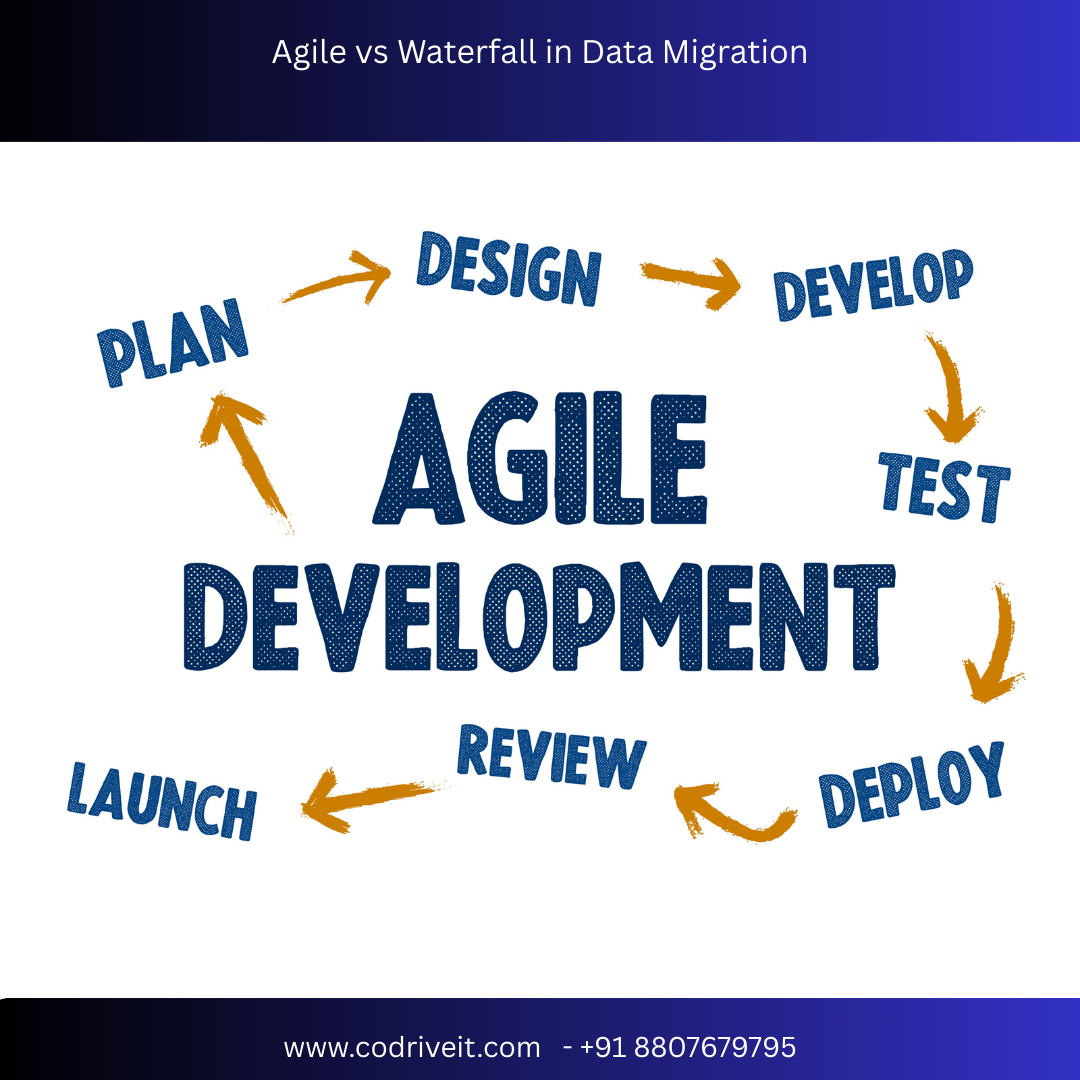
Agile is a flexible and iterative project management methodology where the migration process is divided into smaller cycles called iterations or sprints. Each sprint delivers incremental progress toward the final migration goal.
Instead of migrating everything at once, Agile allows teams to migrate data in phases and continuously improve the process based on feedback.
Typical Agile data migration workflow includes:
Sprint planning
Data extraction and transformation tasks
Iterative testing and validation
Stakeholder feedback
Continuous improvement
Agile focuses on adaptability, collaboration, and rapid problem-solving.
Greater flexibility
Teams can easily adjust migration strategies when new requirements arise.
Early problem detection
Continuous testing during each sprint helps identify and resolve issues quickly.
Faster delivery of results
Organizations can migrate critical datasets earlier instead of waiting for the entire project to complete.
Improved stakeholder collaboration
Regular feedback ensures that business requirements are consistently aligned with the migration process.
Requires experienced teams
Agile works best with teams that have strong technical knowledge and collaboration skills.
Less predictable timelines
Because requirements may evolve, it can be harder to estimate exact project completion dates.
Complex project coordination
Managing multiple sprints and migration iterations requires strong project management.
| Feature | Agile | Waterfall |
|---|---|---|
| Project Structure | Iterative and flexible | Sequential and structured |
| Requirement Changes | Easily adaptable | Difficult after planning |
| Testing | Continuous throughout project | Mostly at the end |
| Delivery Speed | Faster incremental results | Slower but predictable |
| Risk Management | Issues identified early | Risks may appear late |
Understanding these differences helps organizations choose the most appropriate methodology for their migration projects.
Waterfall is often the preferred approach when migration projects involve stable requirements and well-defined data structures.
It works best in situations such as:
Legacy system upgrades with clearly defined data models
Regulatory compliance projects requiring extensive documentation
Small to medium migration projects with minimal changes
Organizations that prefer structured project management processes
In these scenarios, Waterfall provides strong control and predictable outcomes.
Agile is more suitable for complex migration projects that require flexibility and rapid adaptation.
It is ideal for cases like:
Cloud migration projects
Large-scale digital transformation initiatives
Projects involving evolving business requirements
Migrations with uncertain data quality issues
Agile allows teams to handle unexpected challenges efficiently.
Many organizations now use a hybrid approach that combines elements of both methodologies. In this model:
Waterfall is used for initial planning and system analysis.
Agile is used during development, testing, and migration execution.
This hybrid strategy offers both structure and flexibility, making it particularly effective for large enterprise migration projects.
Benefits of a hybrid approach include:
Better risk management
Faster issue resolution
Balanced planning and adaptability
Improved stakeholder involvement
Regardless of the methodology chosen, successful data migration projects follow certain best practices:
Conduct thorough data profiling before migration
Clean and standardize data to improve quality
Use automated ETL tools for efficiency
Implement multiple rounds of testing
Maintain backup and rollback procedures
Monitor system performance after migration
These practices help organizations ensure smooth and reliable migration outcomes.
Choosing between Agile vs Waterfall in data migration depends largely on project complexity, business requirements, and organizational flexibility. Waterfall offers a structured and predictable approach that works well for projects with stable requirements. Agile provides flexibility and continuous improvement, making it ideal for dynamic migration environments.
Many organizations benefit from adopting a hybrid approach that combines the strengths of both methodologies. By carefully selecting the right strategy and following best practices, businesses can minimize migration risks, improve data quality, and ensure successful system transitions.
Effective planning, collaboration, and continuous monitoring remain the key factors for achieving successful data migration projects in today’s rapidly evolving digital landscape.