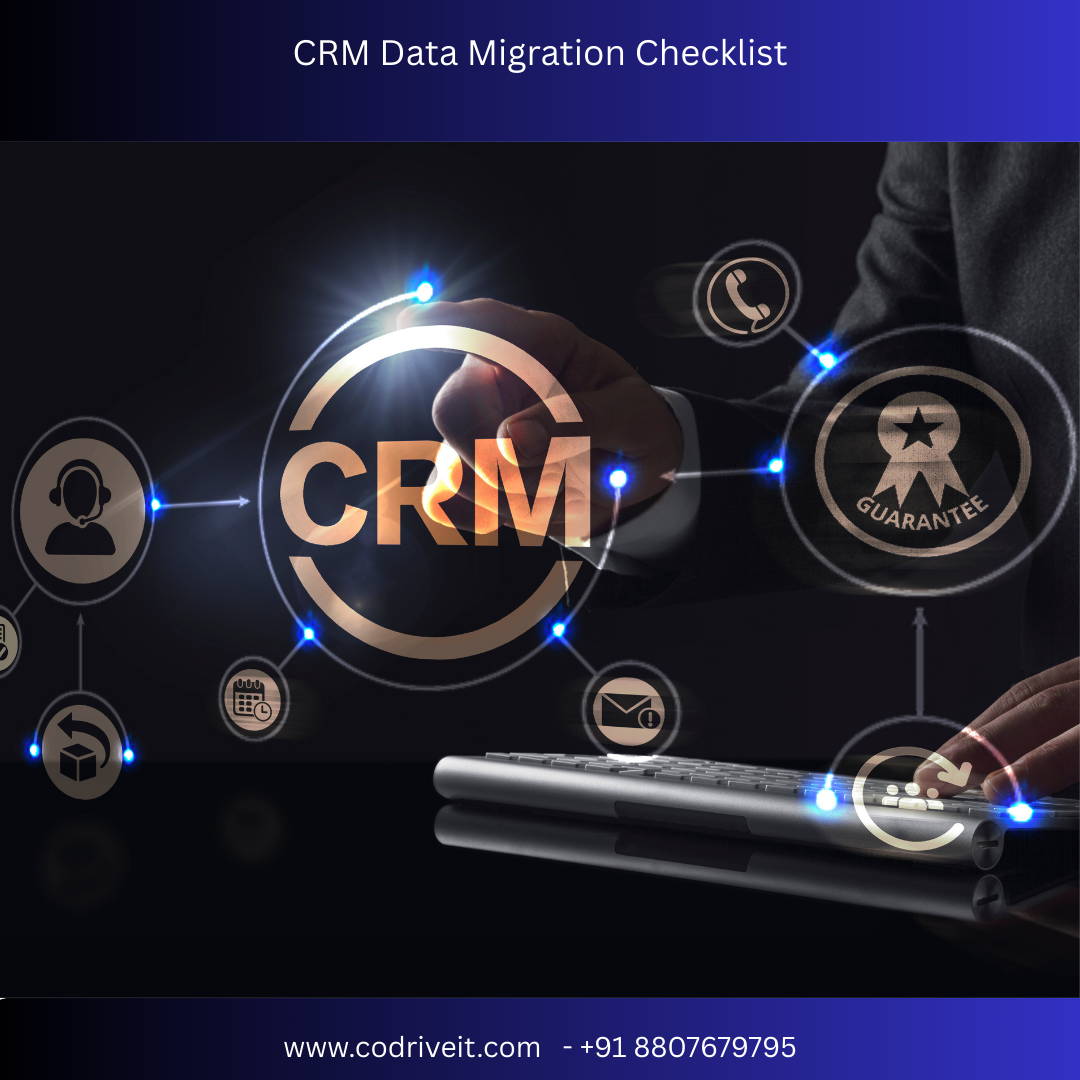

Customer Relationship Management (CRM) systems are essential for managing customer interactions, sales processes, and business relationships. As organizations grow, they often upgrade or switch CRM platforms to improve performance, scalability, and features. However, migrating CRM data from one system to another can be complex and risky without proper planning.
A well-structured CRM data migration checklist helps businesses ensure that critical customer data is transferred accurately, securely, and without disruption. From planning and data cleansing to validation and testing, each step plays a vital role in a successful migration.
In this blog, we will explore a comprehensive CRM data migration checklist, its importance, key steps, and best practices to ensure a smooth transition.
CRM data migration is the process of transferring customer-related data from an existing CRM system or legacy database to a new CRM platform. This data may include:
Customer profiles
Contact information
Sales leads and opportunities
Customer communication history
Support tickets
Transaction records
Marketing data
The objective of CRM migration is to ensure that all critical customer information is accurately transferred while maintaining data integrity and accessibility.
Migrating CRM data without a structured checklist can lead to major issues such as data loss, duplicate records, or system downtime. A checklist ensures that every critical step is completed systematically.
A well-defined checklist helps ensure that all important records are migrated successfully.
Data cleansing and validation steps help eliminate duplicate or outdated records.
Structured planning minimizes errors during the migration process.
A properly executed migration ensures that sales and customer service teams continue operations without disruption.
Clean and accurate CRM data enables better analytics and customer relationship management.
A successful CRM migration involves multiple stages. Below is a comprehensive checklist to guide the process.
Before starting the migration process, organizations should clearly define their objectives.
Key considerations include:
Why the organization is migrating to a new CRM
What business problems the new system will solve
Which data needs to be migrated
Clear goals help guide the entire migration strategy.
Conduct a complete audit of the current CRM system to understand the existing data structure.
Review the following:
Customer records
Sales data
Contact information
Marketing data
Support tickets
This step helps identify unnecessary or outdated data that should not be migrated.
Data cleansing ensures that only accurate and relevant information is transferred.
Common data cleansing tasks include:
Removing duplicate records
Fixing incorrect email addresses
Standardizing contact formats
Deleting outdated records
Clean data improves the efficiency and reliability of the new CRM system.
Data mapping defines how fields in the source CRM correspond to fields in the target CRM system.
For example:
| Source Field | Target Field |
|---|---|
| Customer Name | Account Name |
| Email Address | |
| Phone Number | Contact Phone |
| Sales Lead | Opportunity |
Proper data mapping ensures that information is transferred correctly.
Before migration begins, it is essential to create a complete backup of the existing CRM data.
This backup acts as a safety measure in case any issues occur during the migration process.
Instead of migrating all data at once, organizations should conduct a test migration using a small dataset.
Benefits of test migration include:
Identifying mapping errors
Detecting data transformation issues
Validating system compatibility
Testing helps minimize risks during the full migration process.
Once testing is successful, the full migration process can begin.
During this stage:
Extract data from the source system
Transform data to match the new CRM format
Load the data into the target CRM platform
Automation tools and ETL processes can help streamline this process.
After migration, it is important to verify that all data has been transferred correctly.
Validation checks include:
Record count comparison
Field-level validation
Data relationship verification
Format validation
This ensures that no data was lost or corrupted during migration.
Allow end-users such as sales teams, customer support staff, and marketing teams to test the new CRM system.
They should verify:
Customer records accuracy
Sales pipeline data
Reporting functionality
Workflow processes
User feedback helps identify issues before the system goes live.
Employees should be trained on how to use the new CRM platform effectively.
Training topics may include:
Managing customer records
Updating sales pipelines
Generating reports
Using automation features
Proper training ensures smooth adoption across the organization.
Even after migration is complete, organizations should continuously monitor the system for potential issues.
Monitoring activities include:
Checking data accuracy
Monitoring system performance
Tracking user feedback
Identifying integration issues
Ongoing monitoring ensures long-term CRM success.
Organizations may encounter several challenges during CRM migration.
Poor-quality data from the source system can affect migration accuracy.
The new CRM system may need to integrate with other business applications.
Different systems may store data in varying formats.
Employees may require time to adapt to the new CRM platform.
Proper planning and training can help overcome these challenges.
To ensure a successful CRM migration, organizations should follow these best practices.
Define clear goals, timelines, and responsibilities.
Clean and validate data before migration begins.
Automated ETL tools can speed up the migration process.
Testing helps identify issues early and ensures accurate migration.
Document migration steps, mapping rules, and validation results.
When CRM migration is executed properly, organizations gain several advantages.
Improved customer data accuracy
Better sales and marketing insights
Enhanced customer relationship management
Faster reporting and analytics
Increased operational efficiency
Improved customer experience
A successful CRM migration allows businesses to leverage modern CRM capabilities for better growth and customer engagement.
CRM data migration is a critical process that requires careful planning, structured execution, and thorough validation. Using a comprehensive CRM data migration checklist helps organizations minimize risks, maintain data integrity, and ensure smooth system adoption.
By following best practices such as data cleansing, mapping, testing, and validation, businesses can successfully transition to a new CRM platform without disrupting daily operations.
A well-executed CRM migration not only improves data management but also empowers organizations to build stronger customer relationships and drive business growth.