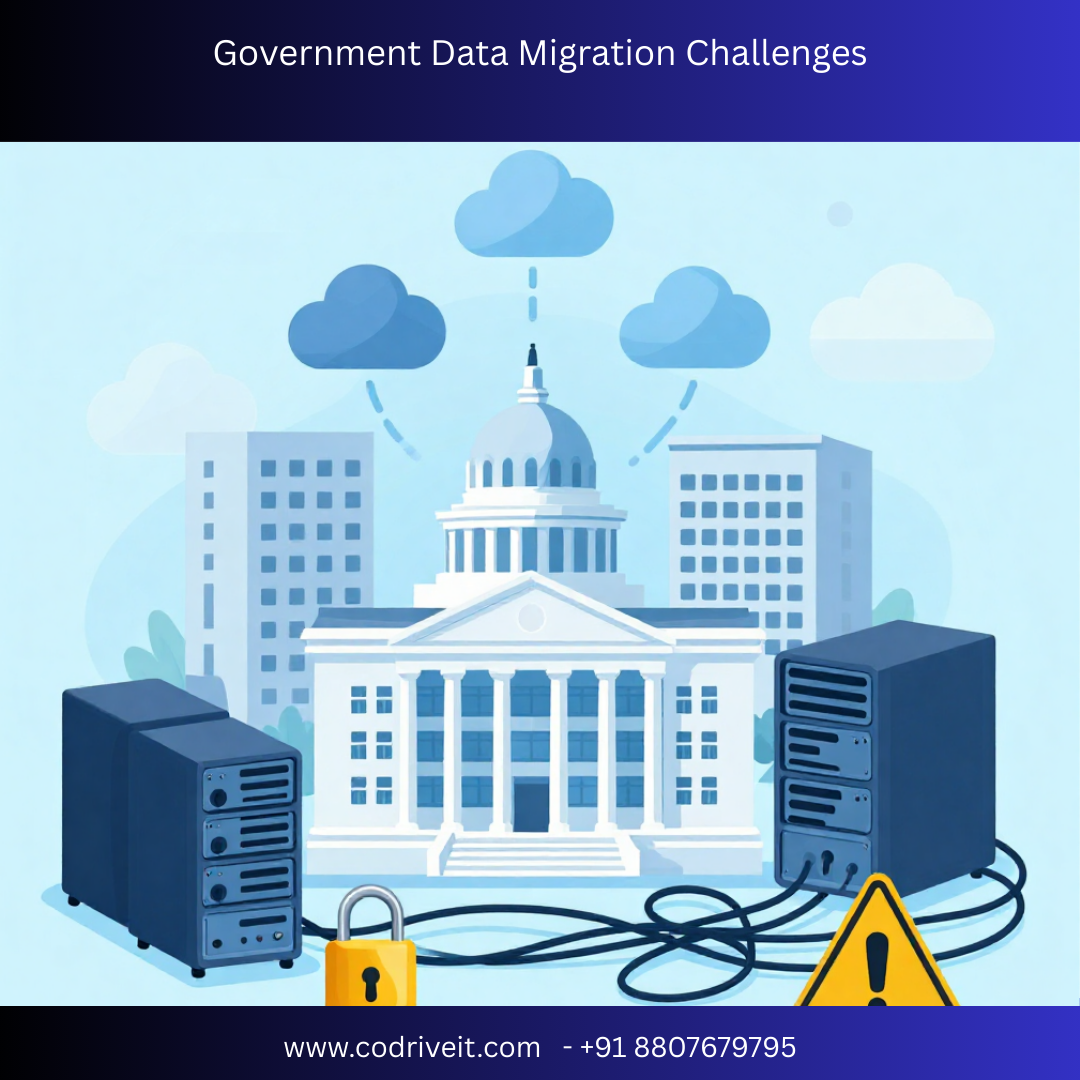

Government organizations worldwide are undergoing rapid digital transformation to improve public services, enhance transparency, and streamline administrative operations. As part of this modernization, many departments are migrating data from legacy systems to modern digital platforms. However, Government Data Migration is a complex process that involves handling massive volumes of sensitive data while ensuring security, compliance, and operational continuity.
Understanding the challenges of government data migration is essential for implementing effective strategies that ensure secure, accurate, and efficient data transfer.
Government data migration refers to the process of transferring data from legacy government systems to modern platforms such as cloud infrastructure, integrated digital systems, or updated databases. This migration may include data from multiple departments such as:
Citizen records and identity databases
Taxation and financial systems
Healthcare and welfare programs
Land and property records
Education management systems
Public service portals
The objective is to ensure seamless integration, improved accessibility, and enhanced data management across government departments.
Many government agencies still rely on outdated systems that limit operational efficiency and scalability. Data migration helps modernize these systems and improve service delivery.
Governments are adopting digital platforms to provide online public services, digital identity management, and automated administrative processes.
Modern data systems enable faster access to citizen information, improving services such as:
Online applications and approvals
Digital certificates and licenses
Automated tax systems
Data migration allows multiple departments to share information, enabling better coordination and decision-making.
Modern platforms provide stronger cybersecurity measures, encryption, and data protection frameworks.
Migrating to cloud-based platforms allows governments to handle large-scale citizen data efficiently.
Migrating government data is far more complex than standard enterprise migration because of strict regulations and large-scale data volumes.
Government agencies manage petabytes of data generated from decades of records. Migrating such large datasets requires advanced infrastructure and optimized migration strategies.
Many government systems were developed years or even decades ago using outdated technologies. These legacy systems often have:
Poor documentation
Proprietary data formats
Limited integration capabilities
This makes migration more complicated.
Government databases contain highly sensitive information such as:
Citizen identity records
Financial data
Healthcare information
During migration, organizations must implement strict data encryption, access controls, and security protocols to prevent breaches.
Government agencies must follow strict regulations and data governance policies. Migration must comply with:
Data protection laws
National cybersecurity frameworks
Public sector compliance standards
Failure to meet these requirements can lead to legal and operational issues.
Improper migration processes can result in data corruption, duplication, or loss, which can disrupt government services and affect public trust.
Government services must remain operational during migration. Any downtime can affect:
Public service portals
Tax filing systems
Healthcare and welfare programs
Minimizing downtime is a major challenge.
Different government departments often use different data formats and structures. Integrating these datasets into a unified system requires complex data transformation and standardization.
To ensure successful migration, governments must adopt strategic approaches and advanced technologies.
Before migration, agencies should conduct a full audit of existing data to identify:
Data quality issues
Duplicate records
Outdated or irrelevant data
This improves migration efficiency.
Cleaning and standardizing data ensures that the migrated information is accurate, consistent, and ready for modern systems.
Governments must implement advanced security measures such as:
End-to-end encryption
Multi-factor authentication
Role-based access control
Secure data transfer protocols
These measures protect sensitive government information.
Instead of migrating all data at once, governments should adopt a phased approach, transferring data in stages to reduce risk and system disruption.
Automated tools help manage large-scale migrations by performing:
Data extraction
Data transformation
Data validation
Error detection
Automation improves accuracy and reduces migration time.
Testing is essential to ensure that all data has been migrated correctly and systems function properly. Key testing phases include:
Data verification
System integration testing
User acceptance testing
This helps detect problems early.
When executed properly, government data migration delivers numerous benefits.
Citizens can access government services faster through digital platforms.
Centralized data systems improve data governance and reporting capabilities.
Digital systems improve accountability and transparency in public administration.
Modern systems reduce infrastructure and maintenance costs.
Government data management continues to evolve with emerging technologies.
Many governments are adopting cloud platforms for scalable and secure data storage.
AI helps analyze large datasets to improve policy decisions and public service delivery.
Blockchain technology can ensure tamper-proof government records.
Integrated digital platforms enable seamless interaction between government departments and citizens.
Government data migration plays a vital role in enabling digital governance and improving public service delivery. However, challenges such as legacy system complexity, security risks, regulatory compliance, and massive data volumes require careful planning and execution.
By adopting strategic migration approaches, advanced technologies, and robust security frameworks, governments can successfully modernize their data infrastructure and deliver more efficient, transparent, and reliable services to citizens.