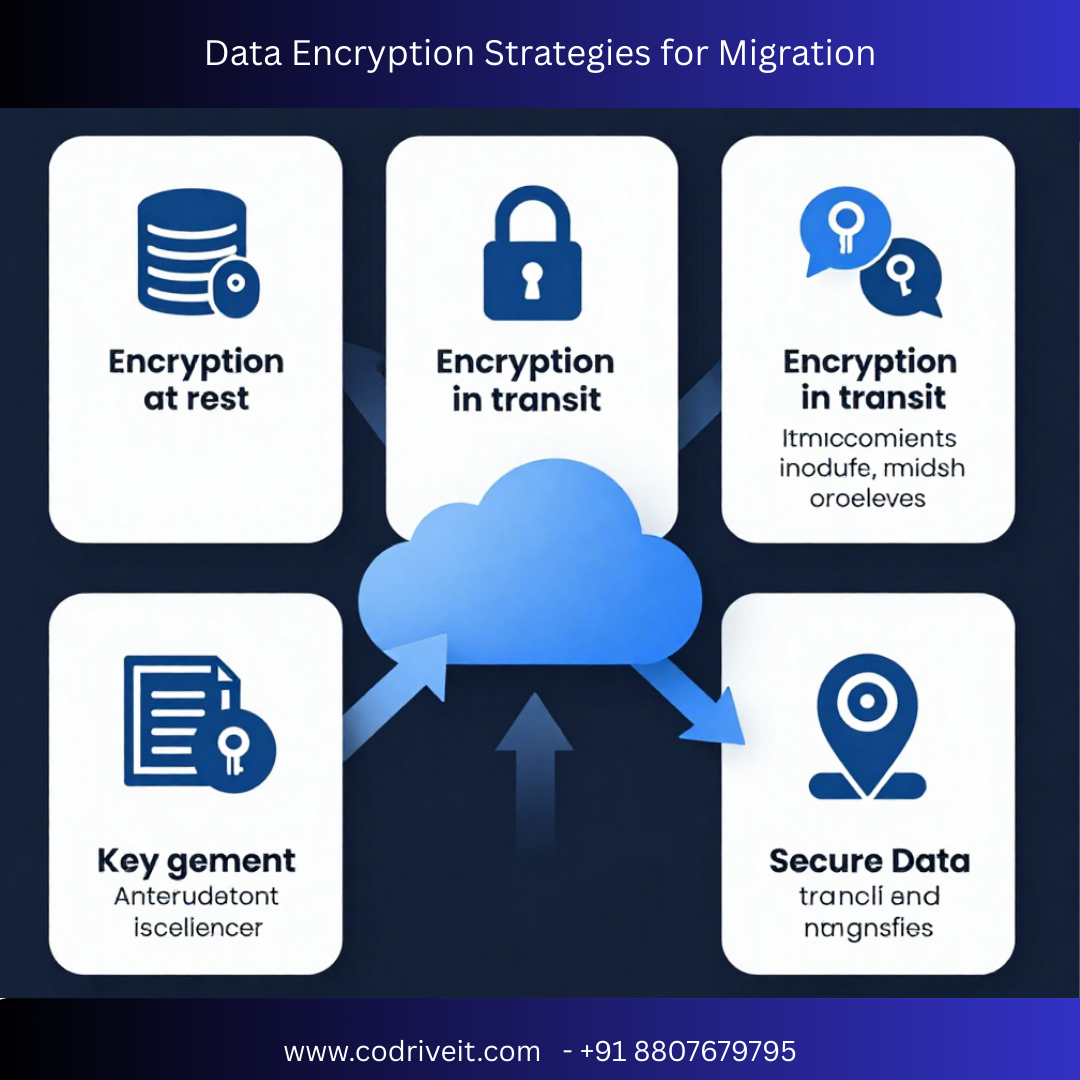

Data migration is a critical process for businesses upgrading systems, moving to the cloud, or modernizing legacy infrastructure. However, during migration, sensitive information becomes highly vulnerable. Implementing strong data encryption strategies for migration ensures data confidentiality, integrity, and regulatory compliance.
In this SEO-optimized guide, we’ll explore the best encryption methods, tools, and best practices to secure your data during migration.
During migration, data may:
Move across networks
Be stored temporarily
Pass through third-party systems
Be processed in staging environments
Without encryption, this data can be intercepted, altered, or exposed — leading to compliance violations and financial losses.
Encryption ensures:
🔐 Data confidentiality
🛡 Protection against breaches
📜 Compliance with regulations like General Data Protection Regulation
🔎 Secure cross-border transfers
Encryption in transit protects data while it moves between systems.
SSL/TLS
HTTPS
SFTP
VPN tunnels
When migrating databases or cloud workloads, always ensure TLS 1.2 or higher is enabled.
Use secure APIs
Avoid unsecured FTP
Enable certificate validation
Monitor network traffic
Data stored temporarily during migration (backups, staging servers, snapshots) must be encrypted at rest.
AES-256 encryption
Full disk encryption
Database-level encryption
Cloud storage encryption
Cloud providers like:
Amazon Web Services
Microsoft Azure
Google Cloud
offer built-in encryption at rest features.
End-to-end encryption ensures data is encrypted before leaving the source and decrypted only at the final destination.
This eliminates exposure risks in:
Middleware
Third-party migration tools
Cloud connectors
E2EE is ideal for highly sensitive data such as:
Financial records
Healthcare data
Customer personal information
Database encryption secures sensitive fields such as:
Passwords
Credit card numbers
Aadhaar or Social Security numbers
Health records
Transparent Data Encryption (TDE)
Column-level encryption
Tokenization
Data masking (for test environments)
| Algorithm | Use Case |
|---|---|
| AES-256 | Symmetric encryption for storage |
| RSA | Secure key exchange |
| SHA-256 | Data integrity verification |
| ECC | Lightweight encryption for cloud |
AES-256 is the industry standard for securing data at rest.
Encryption is only as strong as its key management.
Use Hardware Security Modules (HSM)
Rotate keys regularly
Store keys separately from data
Restrict administrative access
Enable key logging & auditing
Cloud providers offer managed key services such as:
AWS KMS
Azure Key Vault
Google Cloud KMS
Never hard-code encryption keys into applications.
A secure architecture typically includes:
Source system encryption
Secure transport layer (TLS/VPN)
Encrypted staging storage
Controlled decryption at destination
Logging & monitoring
Add multi-factor authentication (MFA) for migration administrators.
Strong encryption helps meet requirements of:
General Data Protection Regulation
Health Insurance Portability and Accountability Act
Payment Card Industry Data Security Standard
ISO/IEC 27001
Encryption reduces legal liability in case of breach investigations.
Avoid these critical errors:
❌ Using outdated SSL versions
❌ Storing encryption keys with the data
❌ Migrating unencrypted backups
❌ Disabling encryption for performance reasons
❌ Forgetting test environment protection
Security should never be compromised for speed.
Allows data processing while still encrypted.
Replaces sensitive data with non-sensitive equivalents.
Ensures every access request is verified.
Prevents ransomware manipulation during migration.
Conduct data classification
Identify sensitive datasets
Choose encryption standards
Configure secure transport protocols
Encrypt backups and staging areas
Implement key management controls
Perform security testing
Monitor migration logs
Validate encryption post-migration
✔ Prevents data breaches
✔ Ensures regulatory compliance
✔ Builds customer trust
✔ Reduces legal risks
✔ Protects intellectual property
Encryption is not just a security layer — it’s a business necessity.
Data encryption strategies for migration are essential for protecting sensitive information during system upgrades, cloud transitions, or ERP modernization. By implementing encryption in transit, encryption at rest, strong key management, and secure architecture, organizations can achieve a safe and compliant migration process.
In today’s evolving cybersecurity landscape, encryption must be integrated into every phase of the migration lifecycle — from planning to post-migration validation.