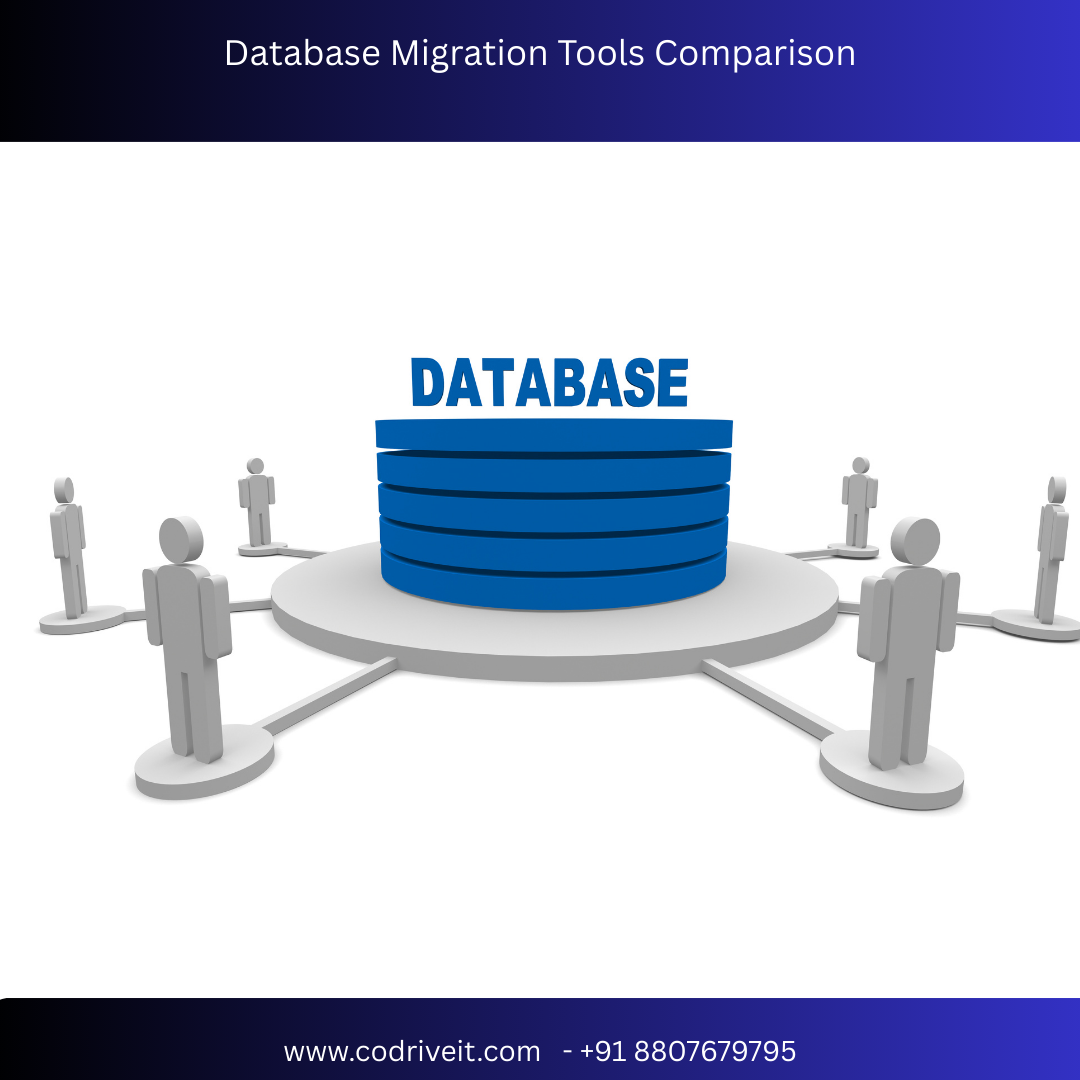

Database migration is a critical step in digital transformation. Whether you're moving from on-premise to cloud, upgrading database versions, or switching platforms like Microsoft SQL Server to MySQL, selecting the right database migration tool can determine the success or failure of your project.
In this comprehensive guide, we provide a detailed Database Migration Tools Comparison, covering features, benefits, limitations, and best use cases to help enterprises make informed decisions.
A powerful migration tool helps:
✔ Minimize downtime
✔ Ensure data accuracy
✔ Automate schema conversion
✔ Reduce manual effort
✔ Improve performance
✔ Enable rollback strategies
Poor tool selection can lead to data loss, corruption, compliance issues, and operational disruptions.
Below is a detailed comparison of leading database migration tools used by enterprises worldwide.
Cloud-based migrations to AWS.
Supports homogeneous & heterogeneous migrations
Continuous data replication
Minimal downtime
Integration with AWS ecosystem
Highly scalable
Managed service
Real-time replication
Primarily optimized for AWS
Limited customization outside AWS
Migration to Microsoft Azure environment.
Online and offline migration modes
Wide database compatibility
Automated schema conversion
Seamless Azure integration
Strong enterprise support
Best suited for Azure workloads
Requires Azure expertise
Cloud-native migration to Google Cloud.
Serverless architecture
Continuous replication
Minimal downtime
Fully managed service
Easy setup
Limited non-GCP flexibility
Small to medium database migrations.
Migration wizard
Schema and data transfer
Cross-platform support
Free tool
Easy for SQL to MySQL conversion
Not ideal for very large enterprise databases
Limited automation features
SQL Server upgrades and backup-based migrations.
Backup and restore
Script generation
Integration with SQL Server
Reliable for SQL Server environments
Strong debugging capabilities
Limited cross-platform migration
Oracle database migrations.
High-speed data export/import
Parallel execution
Data filtering
Optimized for Oracle workloads
Highly efficient
Only for Oracle databases
| Tool | Best For | Downtime | Automation Level | Cloud Support |
|---|---|---|---|---|
| AWS DMS | AWS Cloud | Minimal | High | AWS |
| Azure DMS | Azure Cloud | Minimal | High | Azure |
| GCP DMS | Google Cloud | Minimal | High | GCP |
| MySQL Workbench | Small migrations | Medium | Moderate | Limited |
| SSMS | SQL Server only | Medium | Moderate | Limited |
| Oracle Data Pump | Oracle DB | Low | High | Oracle |
Ensure the tool supports both source and target systems.
Large enterprise databases require high-performance tools.
Choose real-time replication tools for near-zero downtime.
Ensure encryption and audit logging.
Higher automation reduces manual errors.
Open-source vs enterprise-grade pricing.
| Cloud-Based Tools | On-Premise Tools |
|---|---|
| Fully managed | Manual setup required |
| Automatic scaling | Hardware dependent |
| Continuous replication | Scheduled migration |
| Subscription model | License-based |
Cloud migration tools are preferred for modern enterprise transformations.
Schema incompatibility
Data type mismatches
Large data transfer latency
Performance bottlenecks
Downtime planning
Integration failures
Selecting the right tool reduces these risks significantly.
Analyze dependencies and database complexity.
Perform pilot migrations.
Reconcile record counts and financial data.
Prepare contingency plans.
Optimize after go-live.
A fintech company migrating to AWS used AWS Database Migration Service:
Reduced downtime to under 30 minutes
Achieved 99.9% data accuracy
Completed migration 40% faster
Ensured zero data loss
Choosing the right database migration tool is essential for a smooth, secure, and efficient transition. Enterprises must evaluate:
Business goals
Infrastructure complexity
Budget
Compliance requirements
Downtime tolerance
A structured tool comparison helps minimize risk and maximize ROI.
Database migration is not just a technical task — it’s a strategic business transformation initiative.