
In today’s fast-paced digital economy, businesses relying on outdated ERP systems face growing challenges — limited scalability, poor integration, high maintenance costs, and security risks. Migrating from a legacy ERP system to a modern ERP platform is no longer optional; it is a strategic necessity.
Whether you are upgrading to SAP S/4HANA, Oracle ERP Cloud, or Microsoft Dynamics 365, a well-planned migration strategy ensures business continuity, improved efficiency, and long-term growth.
This comprehensive guide explains everything you need to know about Legacy ERP to Modern ERP Migration, including benefits, challenges, step-by-step process, and best practices.What is Legacy ERP to Modern ERP Migration?
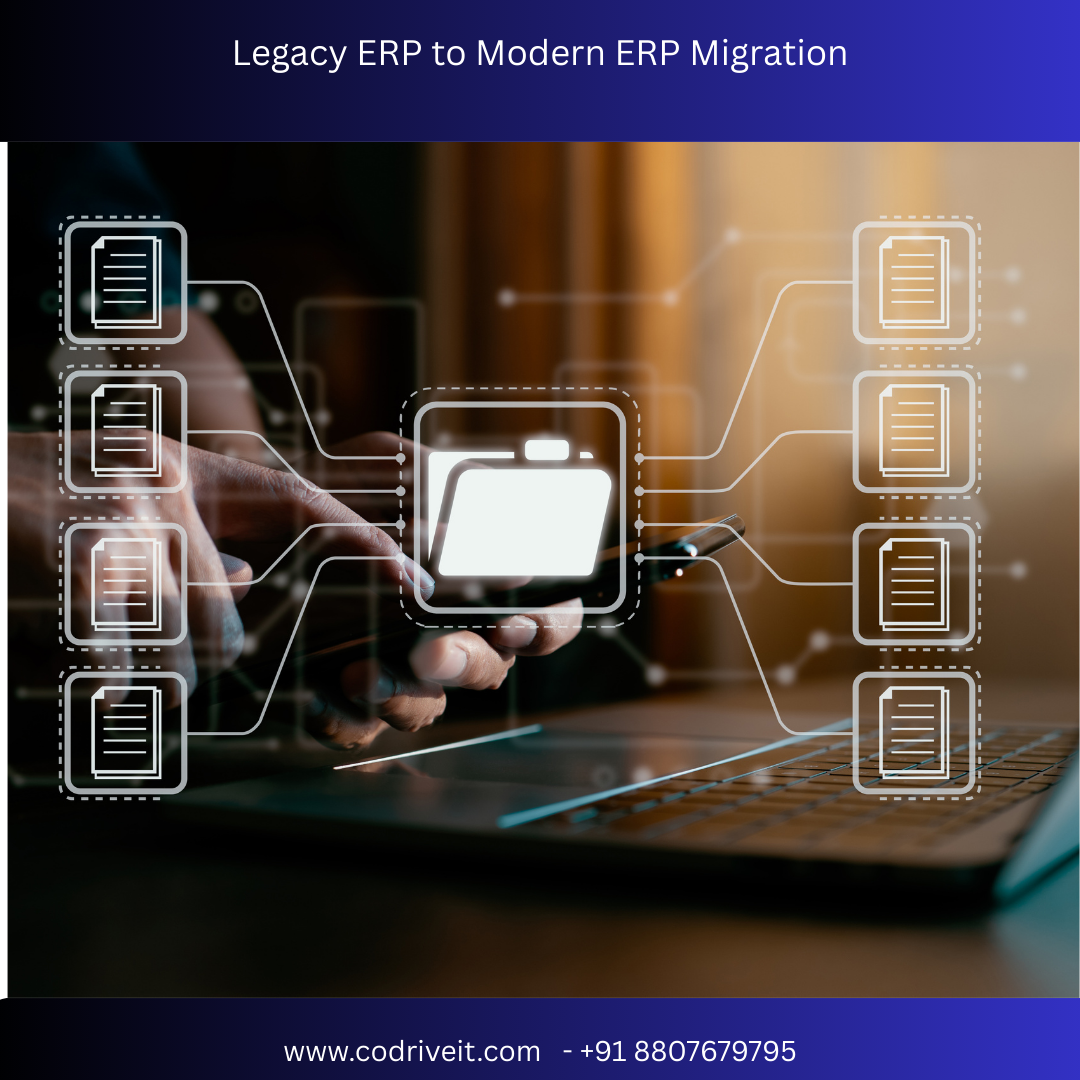
Legacy ERP migration refers to the process of moving data, workflows, and business processes from an outdated ERP system to a new, cloud-based or advanced ERP platform.
Run on outdated infrastructure
Have limited integration capabilities
Require high manual effort
Lack real-time reporting
Are expensive to maintain
Cloud-based flexibility
AI-driven analytics
Real-time dashboards
Automated workflows
Enhanced cybersecurity
Automation reduces manual errors and speeds up processes.
Modern ERPs provide instant access to KPIs and business intelligence.
Scale resources based on business growth.
Cloud systems reduce hardware and upgrade expenses.
Advanced encryption and automated compliance controls.
Despite its advantages, ERP migration can be complex.
❌ Data inconsistencies
❌ Poor data quality
❌ Resistance to change
❌ Customization conflicts
❌ Downtime risks
❌ Integration issues
Addressing these challenges early ensures smoother implementation.
Evaluate:
Current ERP limitations
Business process gaps
Data volume and structure
Customization dependencies
This stage defines migration objectives and ROI expectations.
Before migration:
Remove duplicate records
Standardize formats
Validate financial data
Archive obsolete records
Clean data ensures accurate migration and reporting.
Map source system fields to target ERP fields:
Master Data
Transactional Data
Financial Records
Inventory & Procurement Data
Define transformation rules for format conversion and standardization.
Modern ERP systems require:
Workflow configuration
Role-based access setup
Integration with CRM, HRMS, SCM systems
Compliance configurations
Conduct:
Unit Testing
Integration Testing
User Acceptance Testing (UAT)
Performance Testing
Testing minimizes post-go-live issues.
Final data migration
Switch to production
Monitor system performance
Provide user training
Continuous optimization
Complete switch at once.
Best for: Small to mid-sized businesses.
Module-by-module implementation.
Best for: Large enterprises.
Old and new systems run simultaneously.
Best for: Risk-sensitive industries.
✔ Centralized data management
✔ Improved collaboration
✔ Faster decision-making
✔ Reduced operational cost
✔ Better customer experience
✔ Stronger compliance framework
| Cloud ERP | On-Premise ERP |
|---|---|
| Subscription-based | High upfront cost |
| Automatic updates | Manual upgrades |
| Scalable infrastructure | Limited scalability |
| Remote accessibility | Location-dependent |
Most businesses now prefer cloud ERP due to flexibility and cost efficiency.
Align ERP features with business strategy.
Finance, HR, operations, and IT teams must collaborate.
Train employees to adapt to new workflows.
Professional guidance reduces risks.
Never skip validation cycles.
A retail enterprise migrating from a 15-year-old legacy ERP to Microsoft Dynamics 365 achieved:
40% faster reporting
30% reduction in IT maintenance cost
25% improved inventory accuracy
Real-time multi-branch visibility
Project duration depends on:
Company size
Data complexity
Customization level
Industry regulations
Typical timeline: 3 to 12 months
Legacy ERP systems can slow business growth and increase operational risk. Migrating to a modern ERP platform enables:
Digital transformation
Scalable infrastructure
Real-time analytics
Competitive advantage
A well-planned ERP migration strategy ensures a smooth transition with minimal disruption.
If your organization is still operating on an outdated ERP system, now is the time to modernize and future-proof your operations.